
Pottstown Records That Confirm Residents
No Pottstown record system combines every person into one list. The useful question is narrower: which public record can confirm the relationship at issue? Montgomery County property data can identify a parcel and its current assessment representation. A recorded instrument can confirm parties and recording placement. A public court docket can establish that a case exists, while an archival vital record can support a dated life event when its access rule is met. The state voter tool is intended for a voter to check their own current registration status, not for browsing a local roster.
| Record | What It Confirms | Where | Access |
|---|---|---|---|
| County parcel and assessment record | Parcel identity, property location, assessment representation, and possible owner correspondence data | Montgomery County Property Records | Informational only, not title or occupancy proof |
| Recorded land instrument | Recorded parties, dates, legal-property context, and document placement | Recorder Public Access System | Account required; image and copy rules apply |
| Voter registration status | A voter’s own current registration-status check | Pennsylvania Voter Services | Individual-facing route with statutory list restrictions |
| Public court docket | Case context tied to a party, court, docket number, and dates | UJS Case Search | Protected and sealed material remains unavailable |
| Vital, probate, business, or license record | A life event, estate role, filing fact, or credential status | PHMC, the Register of Wills, and Pennsylvania state custodians | Each has its own eligibility and purpose limit |
Start with a name plus a record-specific fact. An estate question belongs with the Register of Wills and recorded land documents. A former classmate may be better supported by a dated yearbook, directory, or newspaper. A business filing or professional credential establishes that filing fact, not where a person lives. For all of these paths, the custodian’s identifier is stronger than a name match alone.
Check Pottstown Court Docket Matches
Pottstown lies in Montgomery County’s 38th Judicial District. The local Magisterial District Courts serving Pottstown are 38-1-11 and 38-1-12, and the Court of Common Pleas handles county-level matters. UJS Case Search is the statewide public entry for docket sheets, calendars, and case information in supported systems. A name hit is only a lead. Compare the caption, county, court, case type, filing and event dates, parties, and disposition before treating a result as the right person.
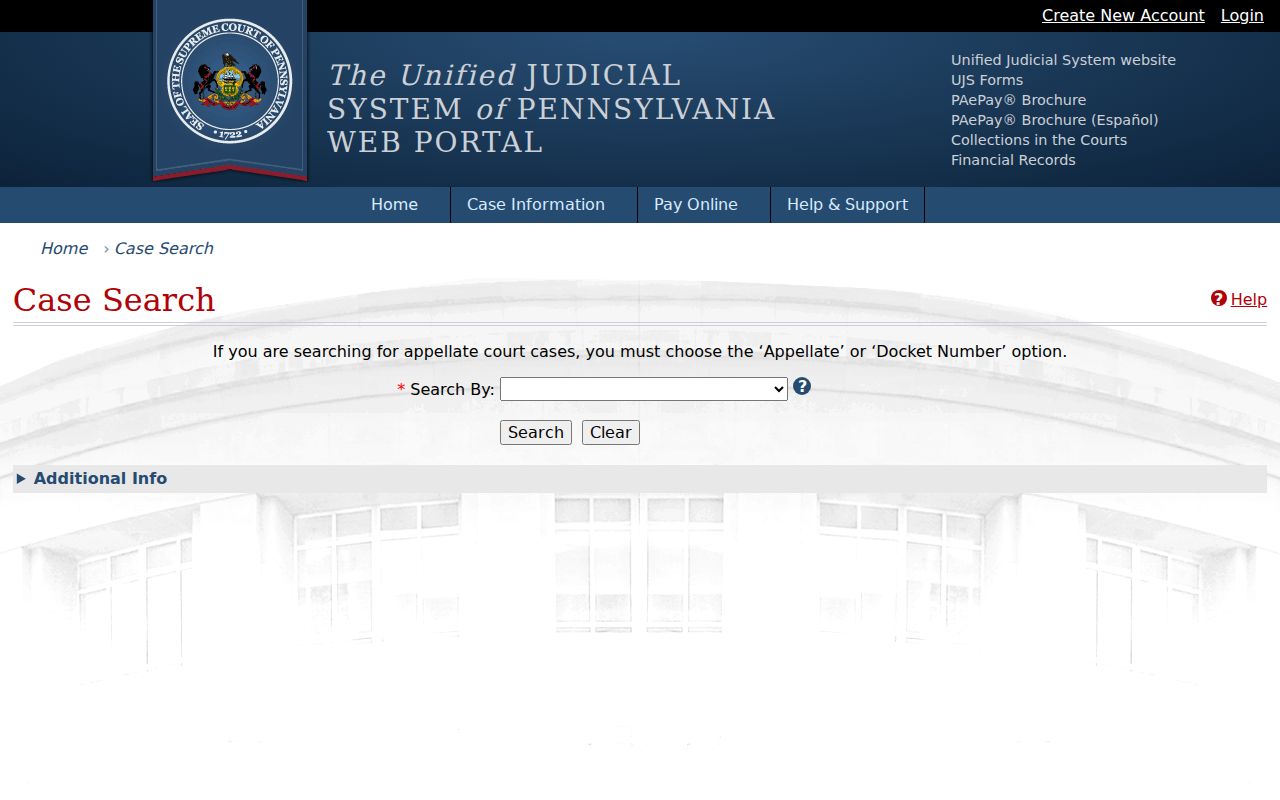
The documented UJS routes include Search By and Advanced Search. Depending on the chosen docket family, narrowing fields can include docket number, citation number, complaint number, parcel number, party last and first name, date of birth, county, judicial district, court office, docket type, case category, case status, filing-date range, judge, and event fields. Choose Montgomery County and the appropriate Pottstown district where applicable. Exact required fields vary by search mode, so a query should be as narrow as the portal permits.
Pennsylvania’s public Case Search interface is pictured here because it is the proper starting point for a documented docket inquiry.
Keep the docket number, court, and dates from a confirmed result. A physical file or certified copy is requested from the office maintaining that case, not by asking staff to decide whether two same-named people are the same person.
Note: UJS policy excludes protected identifiers, sealed and expunged material, and several classes of confidential court information from electronic public access.
Separate Pottstown Residents With Identifiers
Same names are common, and separate records use separate anchors. In the property system, retain the parcel ID and legal description. The parcel’s situs is its physical property location, while an owner mailing address is correspondence information and may be somewhere else. For a docket, retain the court, case number, dates, and case type. For an archival birth or death request, retain the certificate number and event date. For a state entity or license record, retain the entity filing number or license number.
A comparison should test facts that overlap. A deed can support a recorded owner relationship but does not establish the current residents of a property. A docket may establish public case context but does not reveal excluded material. A birth or death record has an event-specific access rule. Where the records disagree, record the discrepancy and ask the office that holds the original about its correction or copy procedure.
| Property result | Parcel ID, property location, municipality, land-use details, sale date, deed book/page, grantor, grantee, and recorded date may appear in the County record structure. |
|---|---|
| UJS docket result | Party context, court, case number, filing or event dates, actions, and disposition are the facts to compare. |
| Archival vital request | Name, event date, and certificate number are the documented placement facts; some birth years also need month and county. |
Use Pottstown Voter Status Properly
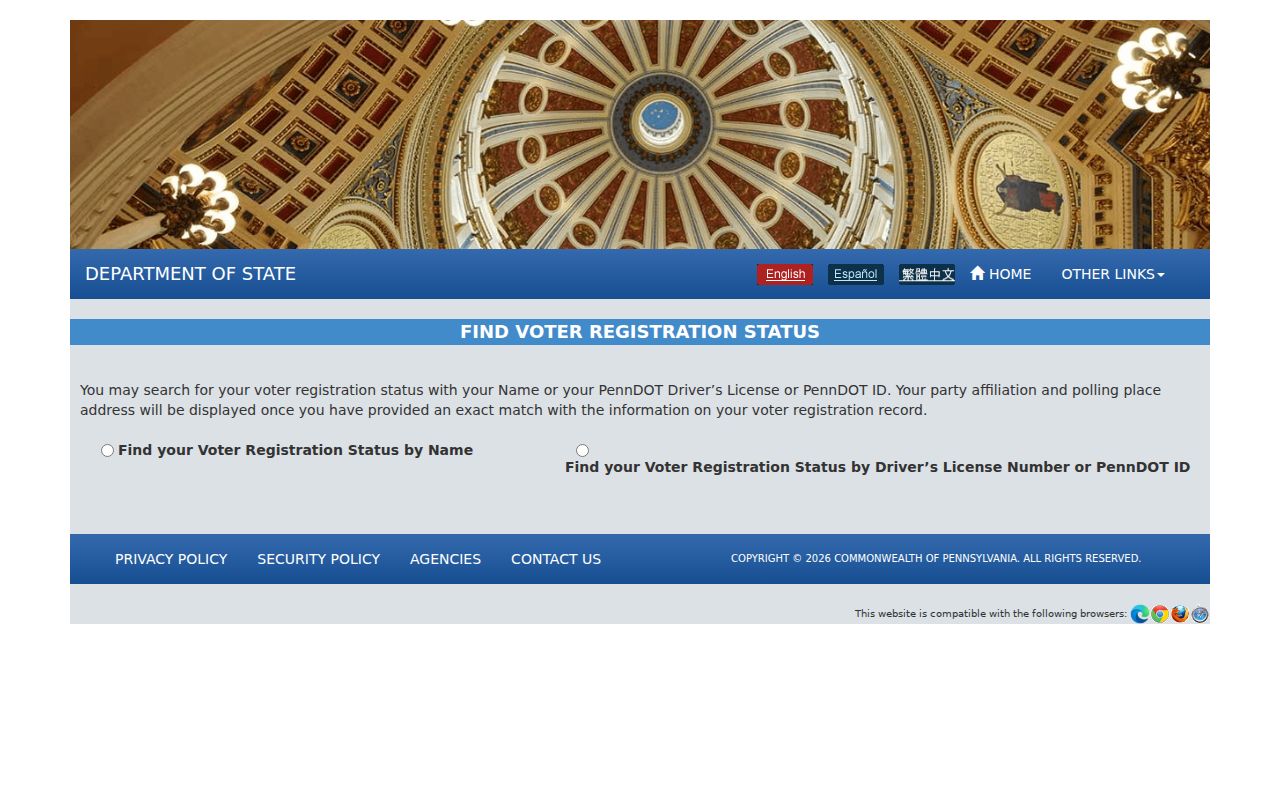
Pennsylvania’s voter registration-status route is for an individual to check their own current registration after a change of name, address, or party. Pennsylvania also directs voters to their county office or 1-877-VOTESPA. It is not a general person finder, and the anti-bot review prevented capture of the live checker’s field labels. That boundary matters: no field-by-field promise should be made for a form that was not captured in an ordinary browser.
The public inspection rule in 25 Pa.C.S. §1207 covers particular election materials, including street lists, under supervision during business hours. Section 1404 requires identification and a written permitted-use statement before inspection of public information lists or certain elector data. A formal Montgomery County request can involve an attestation and defined electoral, political, or law-enforcement use. It is not a substitute for a general personal-record inquiry.
The official voter-status page illustrates the individual-facing route, not a neighborhood or name-browsing tool.
A voter who needs to correct their own record should use official voter services or the county office. Do not infer a person’s residence, household, or protected status from a list category.
Match Pottstown Vital Record Dates
Pennsylvania’s Division of Vital Records is the statewide custodian for births and deaths from 1906 forward. Birth certificates become public through the archival route 105 years after birth, and death certificates after 50 years. The State Archives describes its original holdings as births from 1906 through 1920 and deaths from 1906 through 1975, and it provides non-certified copies. Montgomery County Archives holds county birth and death material before 1906. Marriage records remain with the licensing county, while divorce records follow the court custodian rather than a statewide vital certificate route.
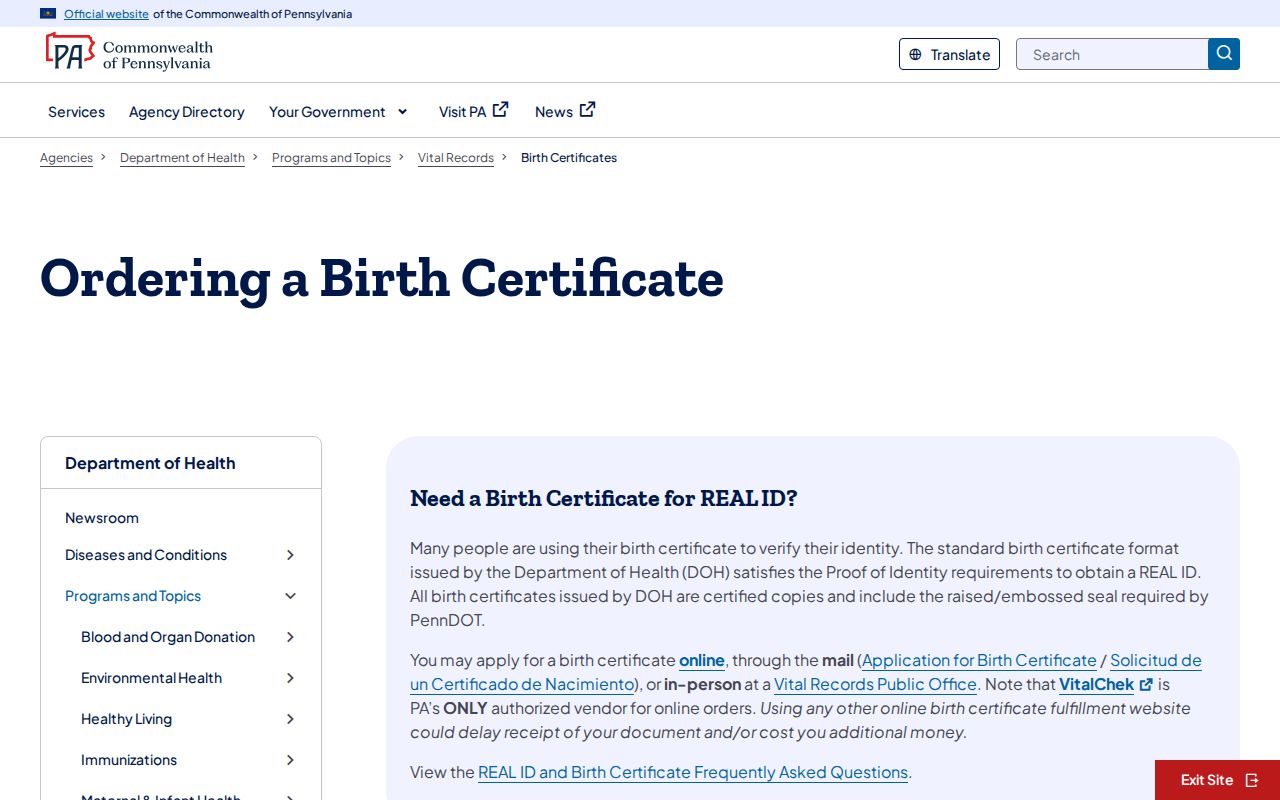
For a public-age archival request, the documented route calls for a name, event date, and certificate number. Birth requests in 1908, 1909, and 1911 also need month and county. The archival copy is $5 per certificate and that fee is retained if the search is unsuccessful. A current certified birth or death certificate has restricted eligibility; the Pennsylvania application lists a $20 standard certificate and a $10 online service fee. Those different paths should never be blended into a single searchable resident record.
Pennsylvania’s birth-certificate page shows the state application and eligibility path for restricted certified records.
Use a public archival index to locate the certificate number first when the date rule is met. For a current certificate, follow the eligibility instructions of the actual vital-record custodian.
Verify a Pottstown Resident Across Records
A careful Pottstown resident-record check moves from a tentative name to a record-specific identifier, then to a second source that can reasonably confirm the same person or event. Avoid making a current-residency claim from a filing, mailing address, or historic mention. When a source has no online result, the correct next step may be the Recorder’s counter, a mail-copy request, County Archives, a library collection, or a targeted Right-to-Know request to the Borough for a defined administrative record.
- Use the County property portal only when an address or parcel connection is already relevant, then write down the parcel ID, situs, and legal-description clues.
- For a recorded ownership question, search the Recorder’s Public Access System with the name, address, or parcel ID, then preserve the document or book/page placement.
- For a public court question, narrow UJS by county, court, dates, and case number, then compare the docket facts rather than relying on a name alone.
- For a historical life event, use the applicable public-age index and certificate number, or contact the county custodian for a pre-1906 series.
- Docket
- A court’s organized record of a case, identified by a case number and showing filed actions and dates.
- Index and image
- An index points to a record. An image is the reproduced document itself and may have a separate viewing, copy, or access rule.
- Certified copy
- A copy issued or authenticated by the custodian for an official purpose. It is different from an ordinary reference copy.
Pottstown Resident Records for Earlier Trails
Older family and classmate questions need sources tied to a date. The Pottstown Historical Society identifies city directories, church records, borough tax and government records, wills and estates, cemetery material, and family-history holdings. Its research form accepts subjects such as city directories, yearbooks, newspapers, church or cemetery work, census, and family history. It quotes $25 per hour for nonmembers and no research fee for members, subject to its stated access arrangement.
Pottstown Regional Public Library’s 2024 microfilm finding aid lists local newspaper material from 1829 through 2013, with the largest run from 1933 through 2013, and Pottstown Area Necrology Books 1 through 3 and an index for 1878 through 1922. The Library of Congress also identifies a Pottstown criss-cross, or street-address, directory for 1950. These dated sources can support a historic lead, but they are not evidence that a person lives at an address now. The historical collections are discussed in more detail in the Pottstown Directory Book.
Note: A historic directory, newspaper, or obituary should be read with its date and source context before it is used to support family-history research.
Pottstown Resident Record Custodian Requests
Pennsylvania’s Right-to-Know Law, Act 3 of 2008, gives a route for records held by covered agencies, but it does not open every protected field. A written request should identify the requester’s name and address, say it is made under RTKL, and describe the record specifically enough for the agency to locate it. State guidance permits in-person, mail, email, or fax delivery. An agency normally responds within five business days, though a timely interim response can extend the expected date under the conditions in 65 P.S. §67.901.
For a Borough permit, inspection, or correspondence question, name the address, date range, record type, and desired format. Courts follow their own public-record policy, and vital records have their own statutory access gates. A narrow request avoids asking a custodian to create a new answer or identify a person from an ambiguous name.
Limits on Pottstown Resident Research
Pennsylvania’s Address Confidentiality Program protects eligible survivors by allowing a substitute mailing address in specified public systems. ACP applications, actual addresses, and waiver proceedings are confidential. Court policy also excludes Social Security and driver-license numbers, victim and witness contact details, sealed or protected records, unexecuted warrants, and other protected material. PennDOT driver and vehicle data are separately governed by Pennsylvania law and the federal DPPA. A missing result is not an invitation to seek around those limits.
Use official records for personal, civic, family-history, estate, and anti-scam purposes. Montgomery County warns that private deed or title-copy solicitations are not County endorsed, so obtain copies through the Recorder’s official route. Errors belong with the office that created or keeps the record, and safety concerns belong with the appropriate public authority.
Lawful use. Pottstown resident research is for personal, lawful record verification. Using information to stalk, harass, intimidate, or harm another person is prohibited and may violate Pennsylvania law.